Dated: September 2, 2005, updated July 2, 2006
War elephants entered the Macedonian military world during the conquests of Alexander the Great. Alexander first encountered them while campaigning against the Persian Empire and later faced them in much greater numbers during his invasion of India. At the Battle of the Hydaspes in 326 BC, the army of King Porus deployed a substantial elephant corps against the Macedonians, demonstrating both the terrifying power of these animals and the difficulties involved in controlling them on the battlefield.
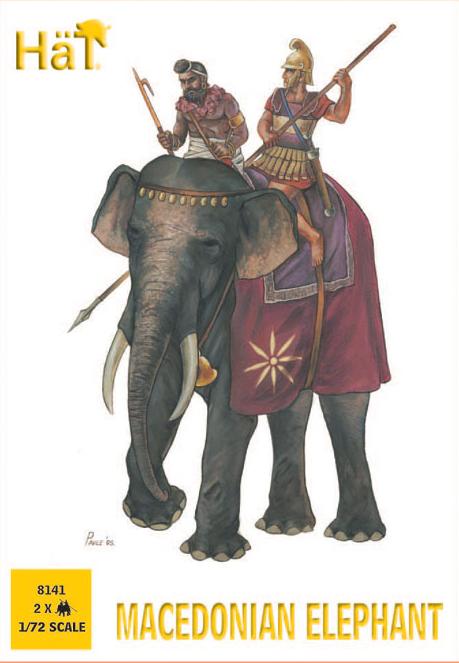
Box art.
Alexander was impressed enough to incorporate captured and surrendered elephants into his own forces. As his armies moved deeper into Asia, additional elephants were acquired and sent westward, helping introduce the animal into the armies of the Hellenistic world. After Alexander's death in 323 BC, his generals and successors competed not only for territory and soldiers but also for control of these valuable animals.
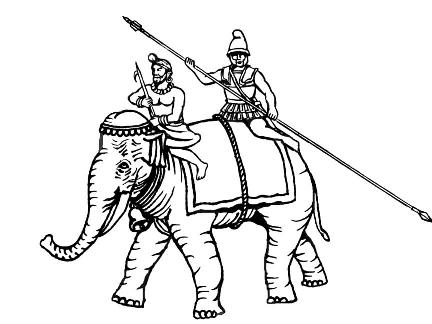
Sprue.
The Successor Wars saw elephants become an increasingly important battlefield arm. They could disrupt infantry formations, frighten horses and create a powerful psychological effect before physical contact was even made. Elephants were also useful for protecting the flanks of a phalanx from enemy cavalry or for preventing mounted troops from crossing particular areas of the battlefield.
Test shot. Each sprue contains the parts to make 1 elephant, 1 driver, 1 Macedonian, a long pike and accessory.
Their limitations were equally important. A wounded or frightened elephant could panic and become dangerous to its own army, while experienced opponents learned to open their formations and attack the animals from the sides. Successful commanders therefore tended to use elephants in cooperation with infantry and cavalry rather than relying upon them alone.
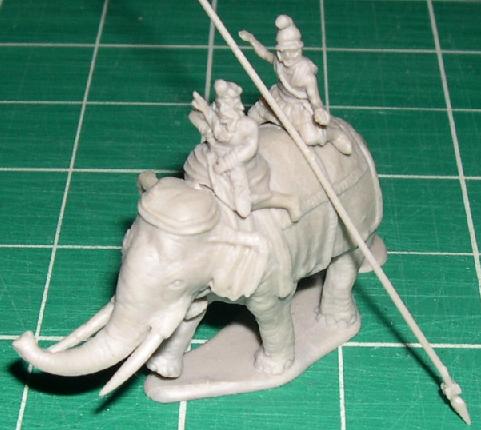
Macedonian elephant with 2 crew.
One of the most dramatic examples came at the Battle of Ipsus in 301 BC, fought between rival Successors of Alexander. Seleucus possessed a particularly large elephant corps, and during the battle his elephants helped prevent Demetrius' victorious cavalry from returning to support the Antigonid infantry. The isolation of the Antigonid phalanx contributed decisively to the defeat and death of Antigonus.
The elephants used by Alexander and the eastern Successor kingdoms were primarily Indian elephants. Their handlers, or mahouts, were often themselves Indian and accompanied the animals as they passed into Macedonian service. At this early stage, elephants did not necessarily carry the large fighting towers familiar from later Hellenistic armies. A mahout and one or more armed soldiers could simply ride directly on the animal's back.
This set represents that earlier style of Macedonian war elephant. Each animal carries an Indian mahout together with a Macedonian warrior armed with a long spear. The elephant itself is an Indian elephant and is equipped with a simple saddle cloth rather than a tower, making it particularly suitable for the period of Alexander and the early Successor Wars.
The set contains two elephants and four crew figures. Each elephant is assembled from separate body and head pieces, while the riders can be positioned independently on its back. The simple arrangement gives the modeller considerable flexibility and also makes the elephants suitable for conversion with alternative weapons or additional crew.
The figures can be combined with our Macedonian infantry, cavalry and other Hellenistic sets to represent armies from the final campaigns of Alexander through the wars of the Successors. They are especially suitable for the decades immediately after Alexander's conquest of Persia and India, when the Macedonian world was rapidly learning how to use these extraordinary animals in battle.
All rights reserved. Any trademark usage or proprietary images on this page are only for the purposes of review or such, and is considered fair dealing and permissible under the Copyright, Design and Patents Act, 1988 (UK). Copyright 2005.