Dated: July 20, 2010, updated Jan 5, 2011.
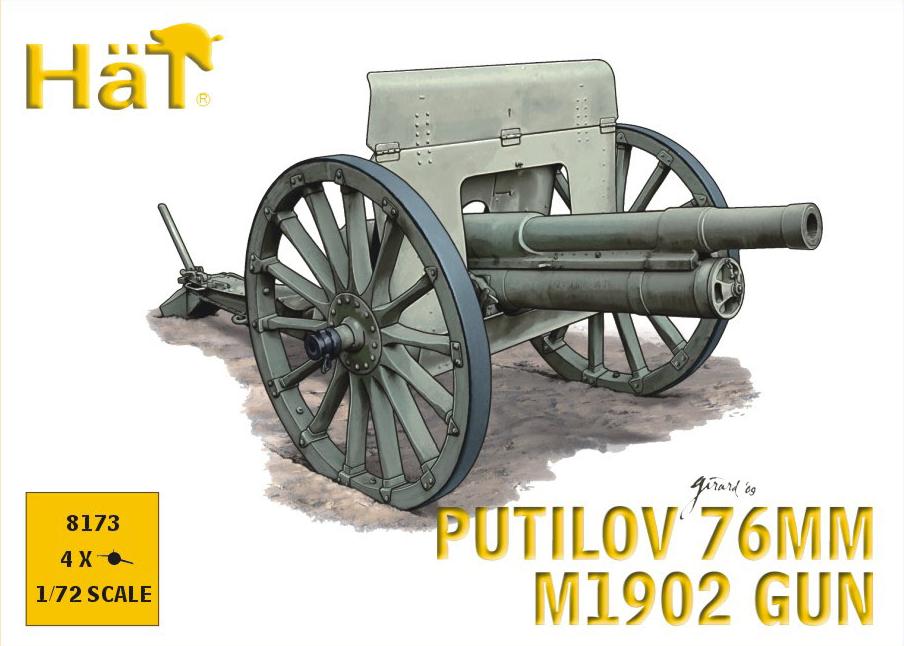
Developed at the Putilov Works in St. Petersburg, the 76.2mm Model 1902 was the principal light field gun of the Imperial Russian Army. Commonly known as the "three-incher," it was a modern quick-firing weapon equipped with a recoil mechanism, an interrupted-screw breech and sights suitable for both direct and indirect fire. Its recoil system returned the barrel to its firing position after each shot, allowing a trained crew to fire much more rapidly than with older field guns that had to be repositioned after firing.
Although designated the Model 1902, production began in 1903 and the gun entered combat before the First World War. It first saw action during the Russo-Japanese War of 1904-1905, including the Battle of Telissu in 1904. Experience in Manchuria demonstrated both the gun's technical qualities and the need for improved artillery training and tactics. Early guns had crew seats beside the barrel, but from 1906 these were replaced by the distinctive protective shield represented in this set.
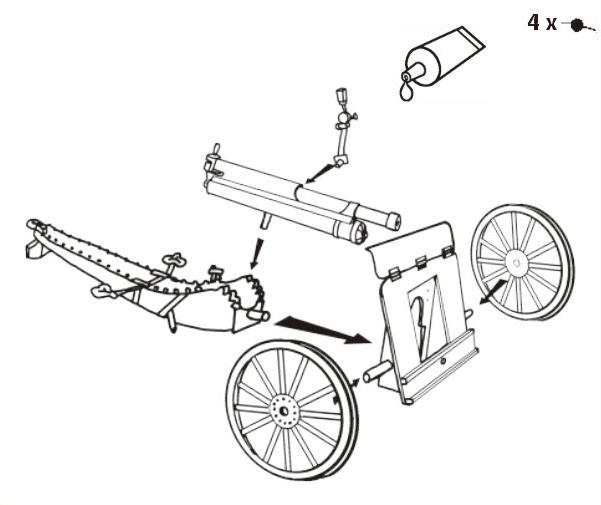
Line drawing
During the First World War, the M1902 became the workhorse of Russian divisional artillery. It fired shrapnel against troops in the open, fragmentation and high-explosive ammunition against field positions, and canister at very short range. Russian batteries used it throughout the campaigns in East Prussia, Poland, Galicia, the Baltic region, Romania and the Caucasus. Large numbers were captured, and both Germany and Austria-Hungary employed captured guns; some were later adapted for anti-aircraft use.
Test shot (may undergo substantial changes prior to release).
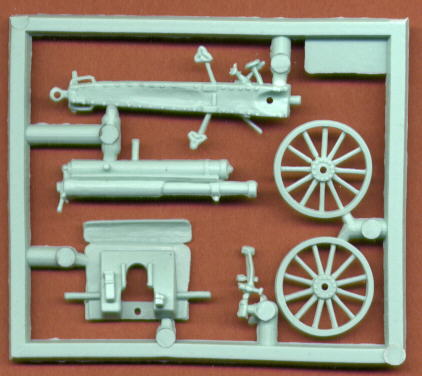
Wheels changed to correct 14 spokes in production sprues.
After the Russian Revolution, the gun served with the Red Army, White armies, nationalist forces and foreign intervention troops during the Russian Civil War. It was also used in the Polish-Soviet War and passed into the arsenals of several states created from territories of the former Russian Empire, including Poland, Finland and Estonia. Romania also possessed and later modernized examples. The result was an unusually long and varied career in which essentially the same weapon could appear on opposing sides.
The M1902 did have later variants and conversions. Poland rechambered many of its guns to the French 75mm standard as the wz.02/26, while the Soviet Union developed the substantially modernized M1902/30 with greater elevation and range. Romania produced its own 75mm modernization, and captured guns were adapted to other roles by the Central Powers.
This set contains four guns, each with the barrel and recoil assembly, shield, carriage and 14-spoke wheels. It also provides useful accessories for building a detailed artillery position, including a bucket, equipment box, aiming equipment and tools for servicing the gun. These extra parts can be placed beside the weapon or combined with our Russian Artillery Crew to create a working battery rather than simply displaying the gun by itself.
The guns can be combined with our WWI Russian Infantry, Infantry Heavy Weapons, Russian Cavalry and Russian Cossacks to create a complete Imperial Russian force. Their broad service also makes them suitable for Russo-Japanese War armies, Red and White forces in the Russian Civil War, the Polish-Soviet War and the armies of several Eastern European nations during the interwar period and the opening stages of the Second World War.
8080 WWI Russian Infantry Heavy Weapons
8257 WWI Russian Artillery Crew
Usage:
WWI
Russian
Russian Civil War
Red and white teams
WW2
Russian, Poles, Finns, Romanians
All rights reserved. Any trademark usage or proprietary images on this page are only for the purposes of review or such, and is considered fair dealing and permissible under the Copyright, Design and Patents Act, 1988 (UK). Copyright 2010.