When Napoleon returned from exile on Elba in March 1815, he was faced with the enormous task of rebuilding an army capable of confronting the forces of the Seventh Coalition. Many veterans rallied to him, but the army of the Hundred Days was not simply a recreation of the Grande Armee of earlier campaigns. Years of war had depleted France's manpower, equipment and experienced officer corps, and the new army had to be organized rapidly for the coming campaign in Belgium.
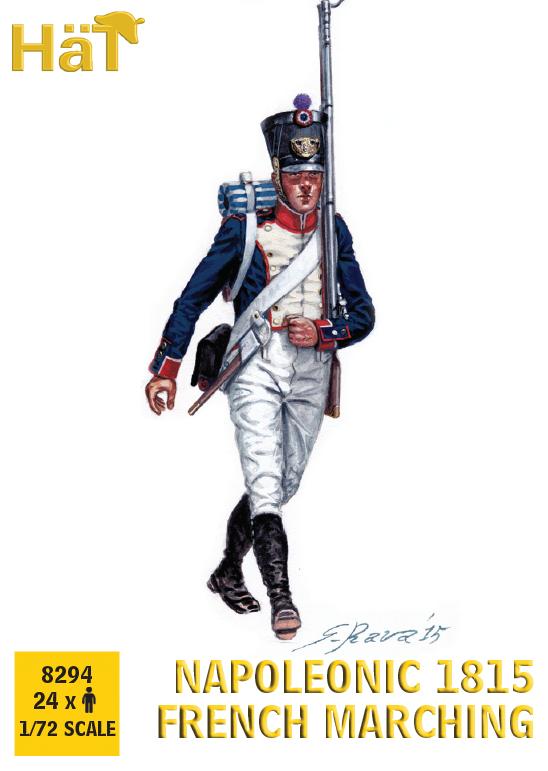
Box front
French line infantry still formed the backbone of Napoleon's army. A battalion normally contained four fusilier companies and two elite companies, one of grenadiers and one of voltigeurs. Fusiliers made up the main body, while grenadiers traditionally represented the larger and more experienced soldiers and voltigeurs supplied light infantry for skirmishing duties. The figures in this set reflect these proportions, allowing a marching battalion to include both ordinary fusiliers and elite-company men.
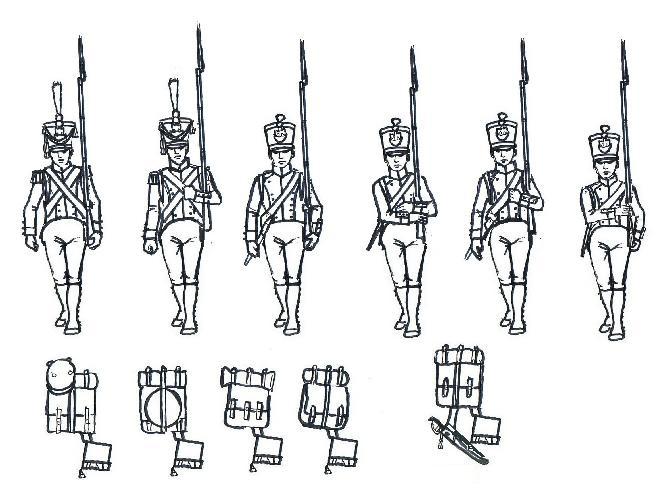
Line drawing
By 1815 the French infantry uniform had evolved considerably from the elaborate dress of the early Empire. The Bardin regulations introduced from 1812 brought a shorter coat with lapels closed across the chest, while the shako remained the standard headgear. Campaign trousers were commonly worn over gaiters, and the overall appearance of the army was increasingly practical. The figures in this set are equipped for the 1812-1815 period and are therefore especially appropriate for Napoleon's final campaigns.
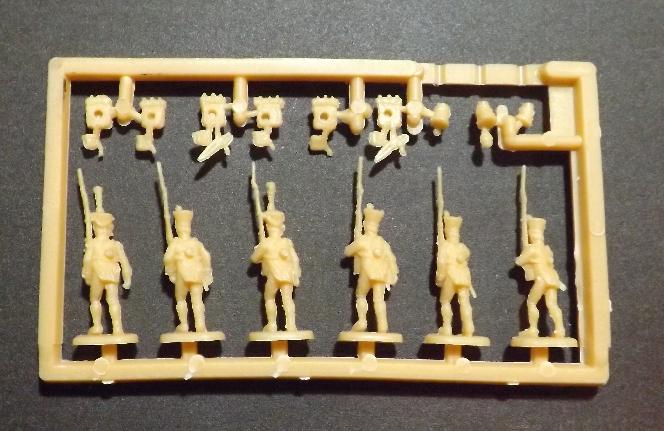
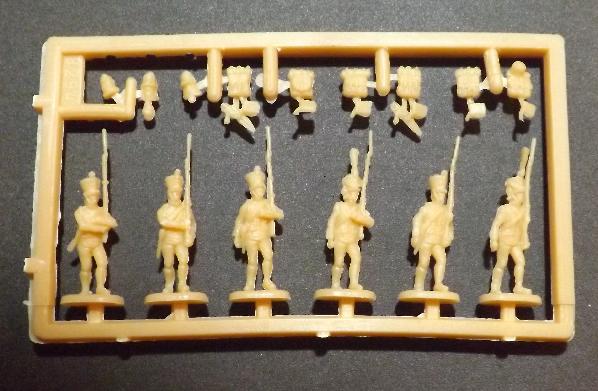
Test shot (may go through substantial revisions prior to release).
The ordinary fusilier carried a single shoulder belt supporting both the cartridge pouch and bayonet. Grenadiers and voltigeurs carried a second belt for the short infantry sabre. Each soldier also carried a knapsack containing personal equipment, with cooking pots or dishes sometimes strapped to the outside. These small differences help distinguish the elite companies within an otherwise closely uniformed marching formation.
Napoleon's line infantry fought throughout the Waterloo campaign. At Quatre Bras on 16 June 1815, French battalions repeatedly attacked Wellington's growing Allied force around the crossroads and the Bois de Bossu. Two days later at Waterloo, line infantry formed the bulk of the great French attacks against Wellington's position, including the assaults by d'Erlon's I Corps on the Allied left and the prolonged fighting around La Haye Sainte.
Marching formations were as much a part of Napoleonic warfare as firing lines and charging columns. Infantry spent far more time moving between positions and battlefields than actually fighting, and maintaining an orderly column was essential if a battalion was to arrive ready for action. French soldiers commonly carried the musket against the left shoulder while marching, as represented throughout this set.
This set contains 24 figures in six marching poses, divided between fusiliers and elite-company soldiers. All carry their muskets on the left shoulder, with variations in arm position giving some variety within the column. Separate knapsacks improve the depth of the figures and include appropriate sabres where required, while additional heads with shakos, plumes and the pokalem forage cap provide useful conversion possibilities.
The figures can be combined particularly well with our French Line Infantry Command set to add officers, drummers, an eagle bearer, NCOs and a sapper. They can also be mixed with our other late-period French infantry and greatcoat sets to create larger formations for the campaigns of 1813-1815. For Waterloo in particular, this set provides the massed marching ranks needed behind the skirmishers and command groups of Napoleon's final army.
All rights reserved. Any trademark usage or proprietary images on this page are only for the purposes of review or such, and is considered fair dealing and permissible under the Copyright, Design and Patents Act, 1988 (UK). Copyright 2017.