French line infantry formed the backbone of Napoleon's Grande Armee. During the great campaigns of the early and middle Empire, enormous columns of infantry marched across Europe, fighting from Spain to Poland and from the Baltic to the Danube. The remarkable speed with which Napoleon concentrated his armies depended upon soldiers accustomed to covering long distances on foot, often carrying everything they required for weeks of campaigning.
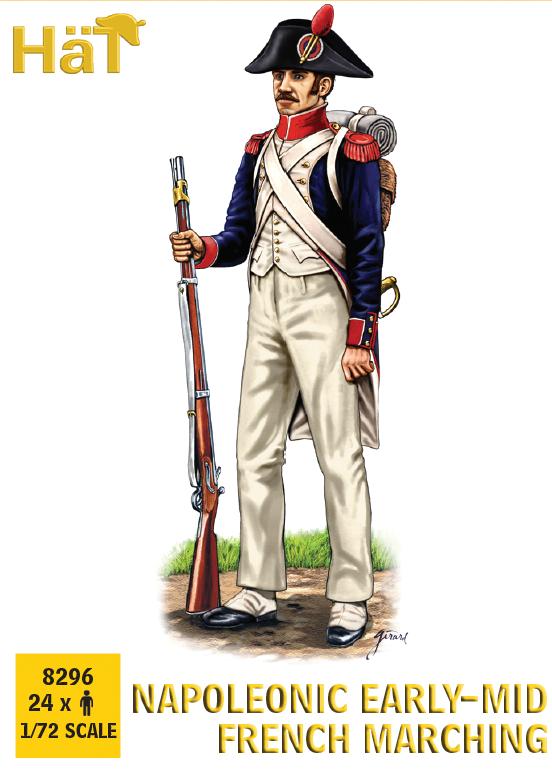
Box front
A French line infantry battalion contained four companies of fusiliers together with a grenadier company and a voltigeur company. Fusiliers formed the majority of the battalion, while grenadiers represented the traditional elite and voltigeurs provided light troops and skirmishers. Although the elite companies had distinctive equipment and uniform details, all could fight together as part of the battalion's formed line or attack columns.
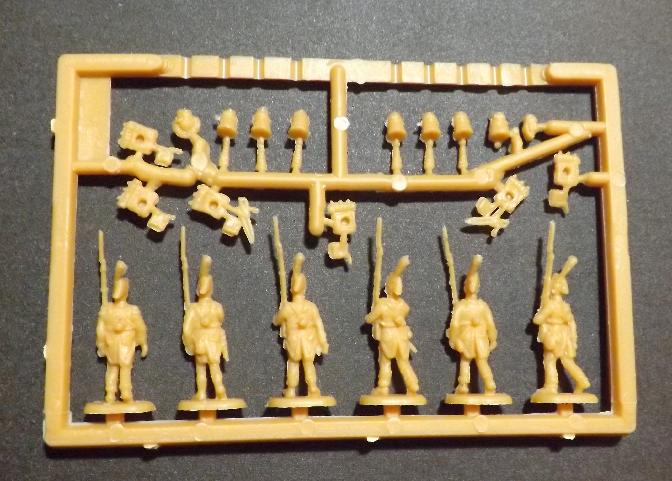
Line drawing
Before the Bardin uniform reforms introduced in 1812, French infantry wore the long-tailed habit with contrasting lapels, waistcoat and breeches or campaign trousers. Headgear changed considerably during this period. The familiar bicorne remained common during the first years of the Empire, while the cylindrical shako was introduced into line infantry service from 1806 and gradually became the dominant headgear. On campaign, forage caps and covered shakos added further variety to the appearance of a marching battalion.
Test shot (may go through substantial revisions prior to release).
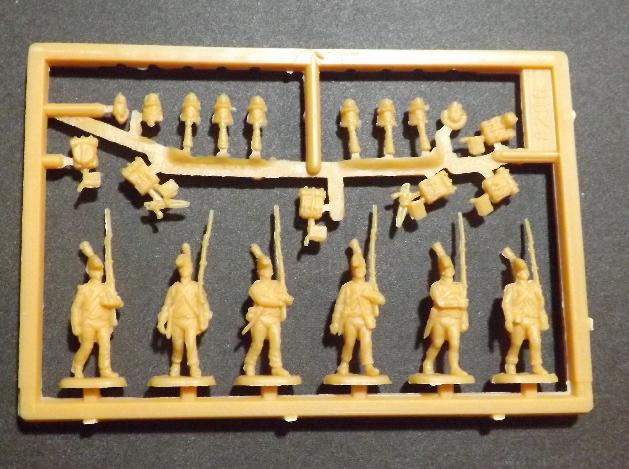
French soldiers normally carried the musket on the left shoulder while marching. The bicorne could also be worn fore-and-aft rather than across the head, making it more comfortable and practical while on the move. Such details distinguish troops actually campaigning across Europe from the more formal appearance associated with parade dress.
This set contains 24 figures in six marching poses, with four fusilier poses and two representing elite-company soldiers. The fusiliers carry a single main shoulder belt, while the grenadiers and voltigeurs have the additional belt and short infantry sabre associated with the elite companies. Separate knapsacks, cartridge boxes and sabres complete the equipment and give the figures greater depth when assembled.
A particularly useful feature is the generous selection of alternative heads. In addition to the bicornes worn by the figures, the sprues provide shakos, a covered shako, a bonnet de police forage cap and an earlier crested helmet. These extras give the modeller considerable freedom to vary a marching column or adapt figures for different units and periods during the early and middle years of the Napoleonic Wars.
The set is particularly suitable for the great campaigns of the Empire before the uniform changes of 1812, including the wars against Prussia, Russia and Austria, the campaigns in Poland and Germany, and the long struggle in the Iberian Peninsula. Marching poses are also ideal for depicting the enormous French columns moving along roads, entering towns, approaching the battlefield or forming behind troops already engaged.
The figures can be combined with our French Line Infantry Command to add officers, drummers, NCOs, an eagle bearer and a sapper. They also complement our other early and middle-period French infantry, grenadier, voltigeur and artillery sets, allowing much larger formations of Napoleon's Grande Armee to be assembled.
All rights reserved. Any trademark usage or proprietary images on this page are only for the purposes of review or such, and is considered fair dealing and permissible under the Copyright, Design and Patents Act, 1988 (UK). Copyright 2017.