The French infantry regiment of the Napoleonic Wars depended upon far more than the mass of fusiliers who formed its ranks. Officers, non-commissioned officers, drummers, standard bearers and specialist soldiers helped control the battalion, maintain its formations and communicate orders amid the smoke and confusion of battle. These command figures were an essential part of the appearance and functioning of Napoleon's infantry.
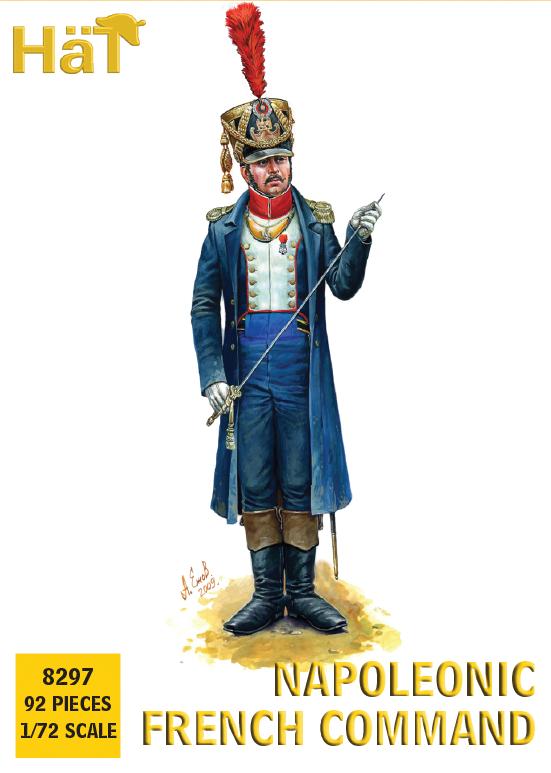
Box front
French infantry officers normally marched and fought close to their men, directing formations and maintaining order during advances, volleys and changes of formation. Non-commissioned officers formed another important layer of command, helping dress the ranks, relay orders and keep companies together under fire. Drummers transmitted many routine signals on the march and battlefield, while the battalion's eagle and colours provided both a rallying point and one of the regiment's most treasured symbols.
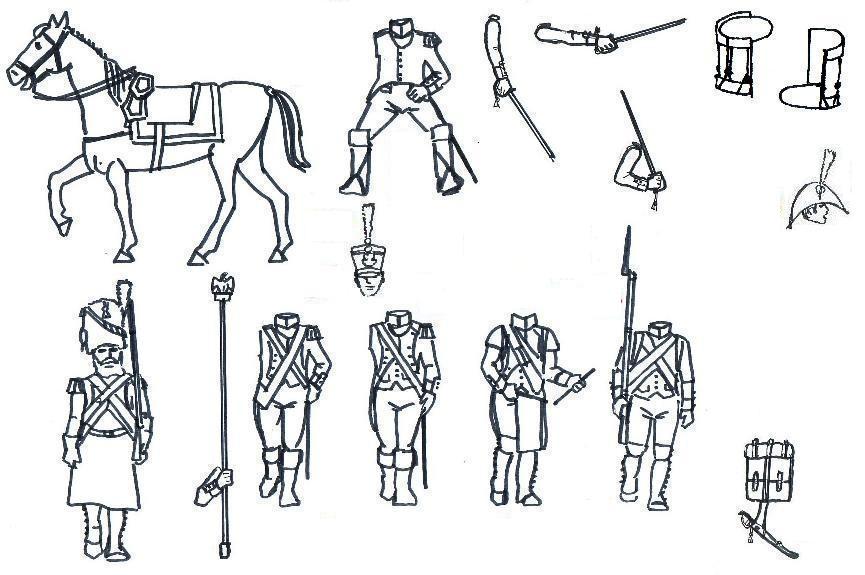
Line drawings
The Imperial Eagle was introduced by Napoleon in 1804 and became the symbolic heart of a French regiment. Modelled upon the Roman aquila, the bronze eagle surmounted the staff carrying the regiment's flag. On campaign the flag itself was sometimes removed or protected while the eagle continued to be carried, making the bare eagle staff represented in this set historically appropriate. Losing an eagle to the enemy was considered a serious disgrace, and soldiers would go to considerable lengths to defend it.
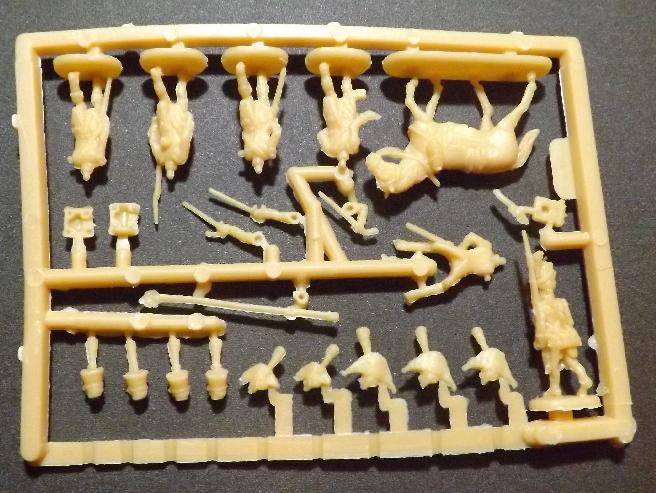
Test shot (may go through substantial revisions prior to release).
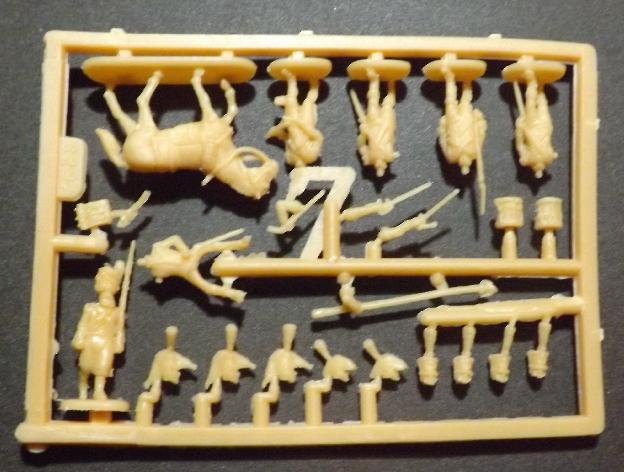
The set also includes a sapper, one of the most distinctive figures in a French infantry regiment. Infantry sappers were selected from strong and experienced soldiers and traditionally wore beards, bearskin caps and leather aprons. Their axes were practical tools for clearing obstacles and preparing roads and positions, but the imposing appearance of the sapper also gave him an important ceremonial role, particularly when marching at the head of the regiment.
This set provides 24 figures in six basic poses: a sapper, non-commissioned officer, drummer, eagle bearer, officer on foot and mounted officer. Most of the figures are assembled from separate parts, with a particularly generous selection of alternative heads wearing shakos and different styles of bicorn. Separate arms provide further choices for the officers, while the standard bearer can be fitted with a paper flag if desired. The result allows considerable variation between the four command groups supplied in the box.
The uniforms are principally suited to the earlier and middle years of the Empire. The infantry figures wear the long-tailed habit coat and other details characteristic of the period before the major French uniform reforms of 1812. The alternative heads and equipment nevertheless provide considerable scope for representing different companies, officers and command personalities within a French regiment.
This set can be combined particularly well with our 1808-1812 French Infantry and our pre-1812 French Line Infantry Marching sets, providing the officers, musicians, standard bearers, NCOs and specialists needed to turn ordinary ranks of infantry into complete battalions. The separate heads, arms and equipment are also useful for conversions with many of our other Napoleonic French infantry sets.
All rights reserved. Any trademark usage or proprietary images on this page are only for the purposes of review or such, and is considered fair dealing and permissible under the Copyright, Design and Patents Act, 1988 (UK). Copyright 2017.